
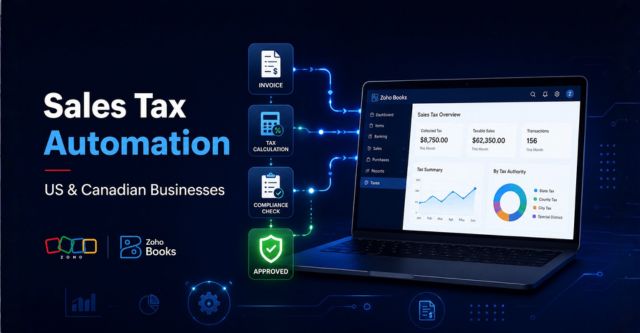
Running a business across North America creates some exciting opportunities, but it also makes sales tax more complex than you might think.
A business in the United States may need to collect state, county, and city taxes, while in Canada you’re often dealing with GST, HST, PST or QST.
For growing companies this stuff can feel like too much too fast, especially if you try to handle it manually. One small tax error can cause compliance trouble, penalties, and then you end up spending hours fixing it. This is where Sales Tax Automation makes a real difference.
Zoho Books automatically works out the correct tax based on your registrations, the customer’s location, product category, and any exemption status.
If you operate across the US and Canada, Sales Tax Automation helps you stay compliant, reduce mistakes, and free up a lot of valuable time.
What Is Sales Tax Automation?
Sales Tax Automation is basically the use of software to calculate, apply, monitor, and report taxes automatically, without all the fuss.
In plain terms, the setup determines:
- Where your customer is located
- What product or service is being sold
- Whether the customer is tax exempt
- Which tax authorities apply
- What rates should be charged
The software then adds the correct tax to the transaction instantly. It’s kind of like using GPS instead of a paper map, only more fiddly.
You still choose the destination, but the software handles the complicated route parts, even when it gets messy and you’re not sure what’s next.
Why Sales Tax Is So Complex in the US and Canada
Sales tax compliance in North America is not exactly straightforward.
In the United States tax rules vary by state and often by county, plus city rules can change the outcome too. A single order may involve several tax jurisdictions at the same time, which makes manual tracking a headache. Businesses also have to watch economic nexus thresholds, basically the point where they get legally pulled into collecting tax in a specific state. It can be confusing , because the “trigger” is very particular.
In Canada, a business may have to deal with different kinds of tax frameworks , like GST , HST, PST, and QST. Each province has its own set of requirements, and honestly those requirements can shift along the way, sometimes without much notice.
As your business grows, the complexity multiplies pretty fast.
Selling to one new state or province may create an entirely new set of compliance requirements.
Why Businesses Are Moving Toward Sales Tax Automation
Many companies begin with spreadsheets and manual calculations.
At first, this worked. But as order volume increases, the process becomes difficult to maintain.
Your accounting team may spend hours each week:
- Verifying tax rates
- Correcting invoices
- Updating spreadsheets
- Tracking exemptions
- Preparing tax reports
This manual effort slows down operations and increases the risk of mistakes.
Sales Tax Automation removes these repetitive chores and makes sure every transaction is calculated the same way, every time, so you don’t end up wondering if anything slipped through.
How Zoho Books Handles Sales Tax Automation
Zoho Books includes built-in Sales Tax Automation for businesses in the US and Canada.
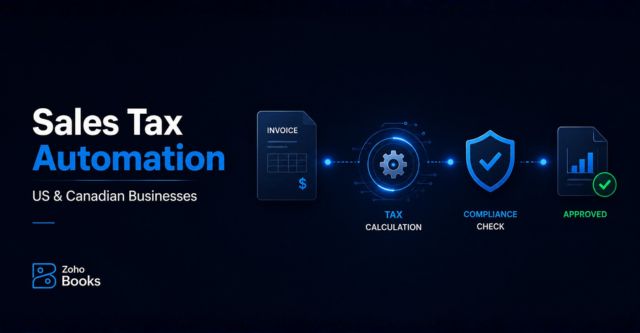
Once activated, the system automatically figures out the correct tax using your business registration details, customer addresses, product tax categories, and the current tax rules.
This means that whether you create:
- Quotes
- Sales orders
- Invoices
- Credit notes
the correct tax is applied automatically.
If you are new to the Zoho ecosystem, our guide on What Is Zoho and How Can It Help Your Business? walks you through how Zoho ties together finance, sales, operations, and customer management into one unified platform.
Key Features of Sales Tax Automation in Zoho
Zoho Books offers a practical set of features designed to simplify tax compliance.
- Automatic Tax Calculation: The software calculates taxes instantly based on customer location, and the taxability rules tied to that situation.
- Real-Time Tax Rate Updates: Tax rules and rates are refreshed automatically when regulations change.
- Nexus Management: You can register the states and provinces where your business is required to collect tax.
- Exemption Handling: Tax-exempt customers such as resellers and nonprofits are managed accurately.
- Audit-Ready Reporting: More detailed tax summaries can make filings easier and help you answer audits with more confidence, not just hope.
Sales Tax Automation for Ecommerce Businesses
Ecommerce companies often create tax obligations in multiple jurisdictions without realizing it.
Selling through platforms such as Shopify, Amazon, and eBay can trigger economic nexus in several states.
Without automation, each order must be checked manually.
With Sales Tax Automation, every order is taxed correctly based on the customer’s location and applicable rules.
This reduces administrative work and helps prevent costly compliance mistakes.
How Sales Tax Automation Supports Business Automation
Tax automation is part of a larger trend toward smarter business systems.
Companies are increasingly swapping out manual work, for connected software, that cuts repetitive tasks and gives better visibility.
If you want to understand how automation can mess with and transform your day to day operations, read our article on Business Automation with Zoho: Solve Common Business Problems.
That page explains how businesses use Zoho to automate accounting, approvals, inventory, and customer workflows, in a way that feels pretty efficient overall.
Sales Tax Automation for Sales and CRM Teams
Tax compliance does not only affect accountants.
Sales teams also benefit when invoices are generated accurately and quickly.
When Zoho Books integrates with Zoho CRM, customer and deal information flows directly into your accounting system.
This reduces duplicate data entry and speeds up order processing.
To learn more, explore our guide on How Zoho CRM Helps Manage Leads and Sales in One Place.
Benefits of Sales Tax Automation
Businesses that implement Sales Tax Automation typically experience several immediate benefits.
- Less manual work for accounting teams
- More accurate invoices
- Faster billing cycles
- Reduced compliance risk
- Better audit readiness
- Easier expansion into new markets
The greatest benefit is confidence.
You know that every invoice is being calculated using current tax rules and your registered jurisdictions.
Who Should Use Sales Tax Automation?
Sales Tax Automation is ideal for businesses that sell across multiple states or provinces, including:
- Ecommerce stores
- SaaS companies
- Manufacturers
- Wholesale distributors
- Subscription businesses
- Professional service firms
If your company is growing and tax compliance is becoming more complex, automation is one of the smartest investments you can make.
Final Thoughts
Sales tax is one of the most complicated parts of running a business in the United States and Canada.
But it does not have to swallow up your team’s time.
Sales Tax Automation helps companies calculate taxes correctly , reduce manual effort, and remain compliant as they expand.
With Zoho Books, the whole flow feels smooth. Every transaction is reviewed, the correct tax rate is applied, and each invoice is produced with confidence.
Your team then spends less time second guessing calculations and more time building something stronger.